
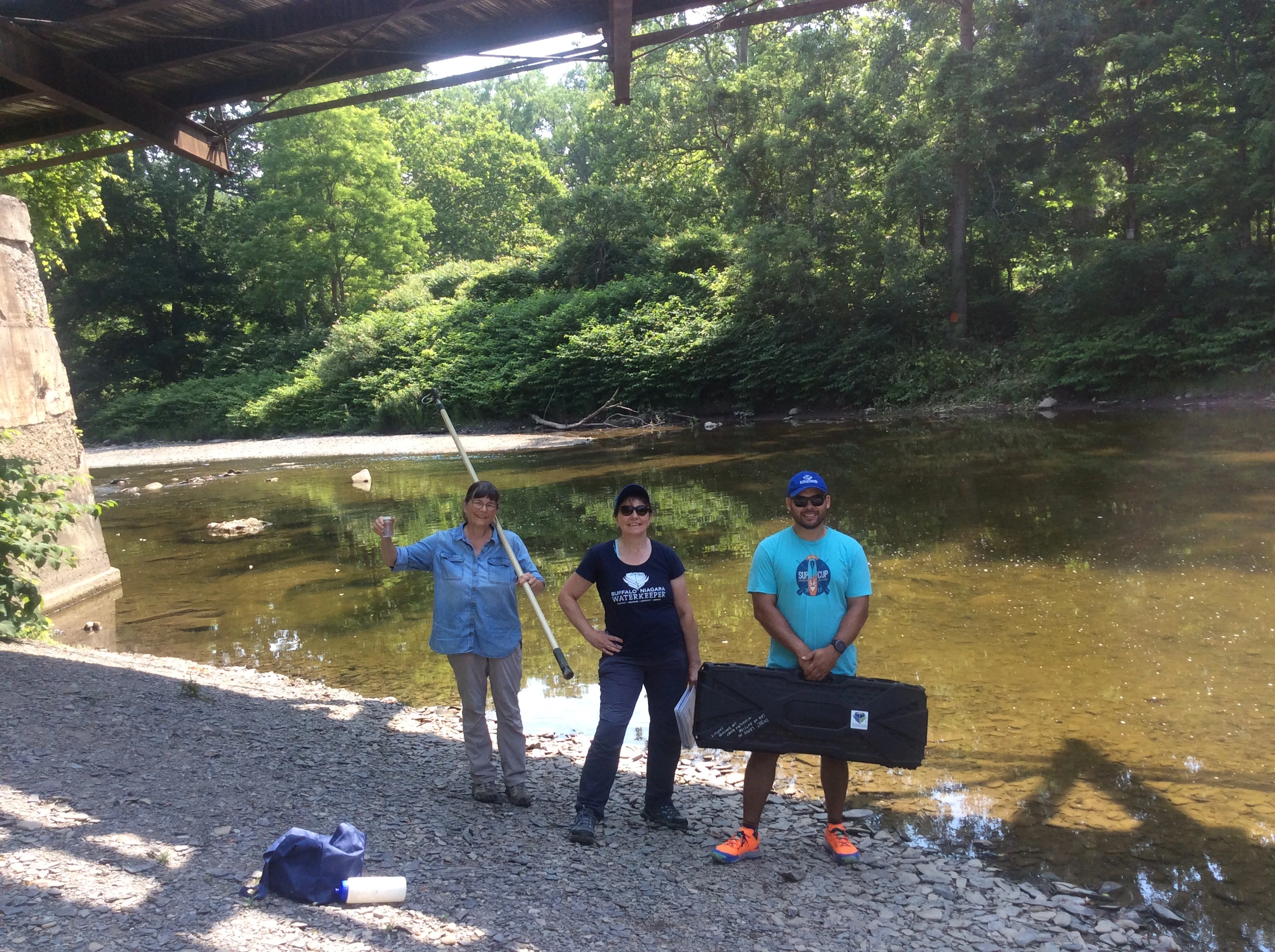
As a founding member of CWA’s Lake Erie Volunteer Science Network (LEVSN), Buffalo Niagara Waterkeeper leverages our standards and tools to monitor and manage Western New York’s vital waterways. Learn how this partnership transforms local volunteer observations into high-impact data.
Listen to this article
Our Great Lakes are vast, but their protection starts at the local level. That’s why we launched the Lake Erie Volunteer Science Network (LEVSN) in 2020 to unite local communities in a collaborative effort to monitor our shared resources. From its inception, the program was designed to fill critical data gaps by empowering residents to play an active role in tracking the health of their own home waters.
What began as a community of practice for sharing best practices has since evolved into a basin-wide initiative. In 2022, LEVSN reached a pivotal milestone with the launch of the Lake Erie Baseline Assessment Framework (LEBAF). This comprehensive standard protocol moved the network toward a more unified approach to monitoring, ensuring that volunteer-collected data is both credible and consistent across different regions. By providing standardized guidance for collection and analysis, LEBAF allows us to produce comparable results that help tell a reliable, "big picture" story about the health of the entire Lake Erie Basin.
Spotlight: Buffalo Niagara Waterkeeper
To kick off our new series highlighting these vital LEVSN partners, we sat down with Rob Coady, Community Engagement Project Manager for Buffalo Niagara Waterkeeper (BNW). As a founding member of LEVSN and a long-standing guardian of Western New York’s waterways, BNW has spent 35 years at the forefront of regional water conservation. Today, they continue to serve as a driving force in the network, turning decades of local stewardship into a model for basin-wide impact.
A Growing Organization
Buffalo Niagara Waterkeeper didn’t start with a massive staff or a fleet of boats. It began as a small group of concerned citizens conducting cleanups along the Buffalo River.
"I’m standing on the shoulders of giants," Rob says. "We’ve grown to a staff of 25 and over 60 programs, but volunteers remain our core. They are our eyes and ears on the water where we can’t be every day."
Through the LEVSN program, BNW manages eight teams of volunteers covering about 60 sites throughout Western New York. These dedicated residents are collecting reliable data, monitoring pressing water quality issues like Harmful Algal Blooms (HABs) and other local watershed challenges.
From Local Streams to a Bigger Picture
One of the biggest hurdles in water conservation is data fragmentation. Before LEVSN, different groups collected data in different ways, making it hard to see the "big picture."
Rob explains how the partnership with CWA and the adoption of the Lake Erie Baseline Assessment Framework (LEBAF) changed their process:
"Standardizing has allowed us to zoom out and look at the overall state of Lake Erie. It helps us tell a story at a larger scale. When you think about a system that provides water to 40 million people, understanding the tributaries is critical to understanding what happens when people turn on their taps."
How CWA Supports the Hubs
While BNW brings the local expertise, Cleveland Water Alliance provides the regional framework and standardized tools to help them reach the next level. Rob highlighted several ways CWA has directly impacted their success:
- Technology Pilots: In 2021, CWA and BNW collaborated on a HABs microtoxin analysis pilot, using cutting-edge tech to investigate yearly blooms in Niagara Falls.
- Funding & Credibility: By integrating LEVSN’s high-standard protocols into their own Quality Assurance Protection Plan (QAPP), BNW was able to secure new funding to sustain their monitoring programs.
- Professional Connection: Beyond the data, the network fosters collaboration. Rob recently co-presented with CWA’s Max Herzog and other LEVSN partners at the Healing Our Waters conference in Rochester.
Protecting Our Water Ways
"These waterways have been degraded for decades, and it’s going to take decades to undo that mismanagement," Rob says. "It’s going to take heads, it’s going to take hearts, and it’s going to take hands."
Through LEVSN, we are bridging the gap between local passion and regional impact, turning individual observations into a powerful, standardized dataset that can drive real policy change. As Buffalo Niagara Waterkeeper continues to lead the charge in Western New York, CWA remains committed to scaling this model across the entire Lake Erie Basin—one volunteer and one waterway at a time.
Get Involved
Are you ready to join the movement? Buffalo Niagara Waterkeeper has several ways to help:
- Join Riverwatch: Become a citizen scientist and help monitor water quality at sites throughout the Niagara River and Lake Erie watersheds.
- For more opportunities, visit the BNW Volunteer Hub to find the program that best matches your passion.
CWA is always looking to expand our network of local partners. Is your organization interested in becoming a LEVSN monitoring hub? Contact us here to get started.

.svg)


.webp)
.webp)
.webp)


