
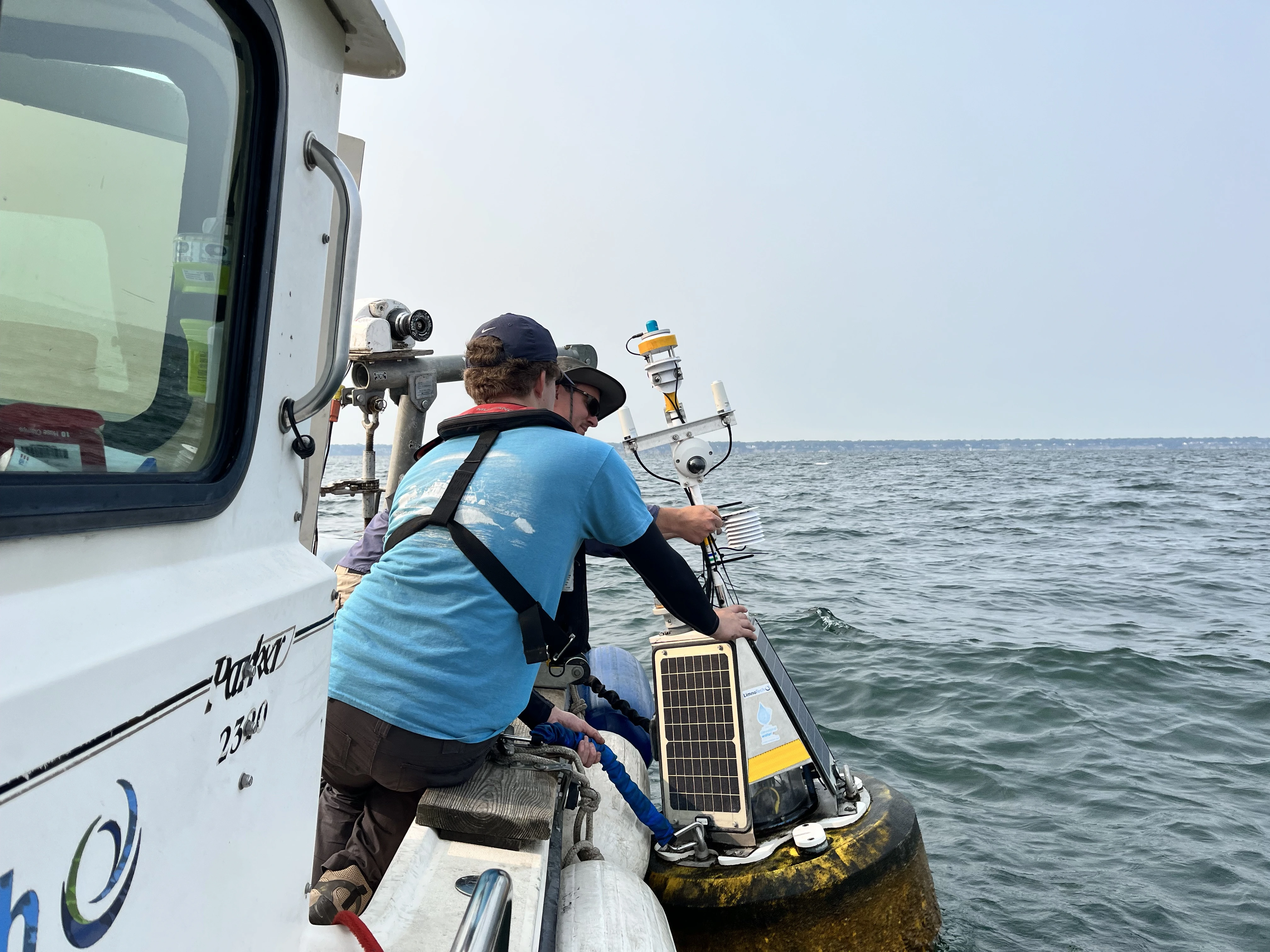
Learn what it takes to launch and maintain the world’s largest digitally connected freshwater network. From planning for shifting lake conditions to ongoing maintenance, see how we ensure Lake Erie’s smart buoys provide critical data while serving as a real-world testbed for water technology.
Listen to this article
As spring arrives, it brings with it warmer weather, increased rainfall, and water conditions that require constant monitoring and treatment. In response to these shifting needs, our fleet of smart buoys and sensors are deployed across Lake Erie each spring to supply data to water managers and test technology that monitors these ever-changing conditions. Because our environmental challenges are always evolving, there is an urgent need for tools that can monitor our water more quickly, with greater precision, and across a wider range of parameters.
These smart buoys and sensors are the backbone of our Smart Lake Erie Watershed (SLEW), a massive network of hundreds of IoT sensors and telecommunications infrastructure that covers nearly 8,000 square miles. However, getting this system ready for the season is a rigorous process that begins long before the first buoy is ever deployed.
Off-Season Prep
To understand what goes into this process, we sat down with Zach Gordon, a Product Engineer at LimnoTech and its subsidiary, Freeboard Technology. Freeboard is a vital partner for our deployments, and Zach is heavily involved in the day-to-day operations, helping to build, maintain, and deploy the very technology that keeps the watershed connected.
Preparation for a spring launch begins as soon as the buoys are pulled out of the water for the winter. Zach notes that the first step is often the most overlooked and "least glamorous" part of the job: cleaning. After a full season in the lake, the buoys return covered in algae, mineral deposits, and bird droppings.
"The solar panels get really cloudy, which hurts their power generation capabilities," Zach explains. This buildup isn't just a cosmetic issue; it can interfere with the power budget of the sensitive electronics on board. Every sensor must be scrubbed, tested, and calibrated against lab standards. We want to make sure that they’re operating the best they possibly can... making sure they’re reading according to standards and providing good data."
Deployment Day
When deployment season begins in the spring, the work moves from maintenance to the open water. A typical buoy deployment involves a crew of two or three people on a specialized vessel equipped with a crane.
The process is physically demanding and technically precise. Deployment involves the management of heavy anchoring chains, delicate wiring, and mooring lines while the boat is in constant motion. For deployments in and near Cleveland, the team is often joined by students from Argonaut, a local organization providing youth with hands-on maritime and aerospace career experiences. They provide essential support to the crew while gaining real-world experience in maritime technology. Once the team reaches the mooring location, a pre-coordinated spot where the buoy will be anchored, they use a crane to lift the buoy over the side of the boat and into position. Because the team often has to boat across the lake or drive between distant launch points, these are frequently long days.
"One of the more stressful parts of the buoy days is just watching the weather," says Zach. "We want to make sure that the wave conditions and the wind conditions are really conducive to a safe and successful deployment." Because things can change quickly on Lake Erie, the team's success depends entirely on finding the right window of manageable lake conditions.
A Real-World Testing Ground
Beyond monitoring lake conditions, SLEW acts as a real-world laboratory for freshwater technology. Each deployment season, Cleveland Water Alliance leverages this infrastructure to help innovators test and trial their technologies in natural environments.
Zach explains that SLEW’s established history of data is a major asset for companies looking to trial their technology. Because the network spans such a diverse range of environments, it allows the team to match an innovator's specific needs with the right location.
"We can provide really good information to folks who are trying to utilize new technology on where they might want to deploy it, how they might want to deploy, or even when they might want to deploy it," Zach says.
Our testbed network offers innovators a variety of testing locations beyond the open-water buoys. This includes deployments near municipal water intakes, as well as stationary sensors mounted on bridges and docks. Depending on what a technology is designed to monitor, our team identifies the most effective environment to ensure the trial is informative and effective.
Advancing Innovation
These tech deployments are complex and require extensive logistics and planning long before trialing. The team must determine whether the technology should be integrated directly into our buoy's infrastructure, placed at a stationary land station, or trialed at a partner host site.
By deploying new technology directly alongside our established tools, we provide a direct side-by-side comparison. This allows innovators to validate their data against proven sensors in real-time. It also provides invaluable operational feedback on how their equipment handles the ever-changing environment of Lake Erie, which simply can’t be replicated in a controlled lab setting.
Ongoing Maintenance and Data Integrity
The work doesn’t end once the buoy is stationed. To ensure the measurements remain accurate, the team performs regular check-ups throughout the summer. These maintenance visits provide another great hands-on learning opportunity for the students at Argonaut. As the sensing and monitoring field changes rapidly, gaining direct experience with the latest instruments is incredibly valuable for future maritime careers.
While some sensors are rugged and can run independently for long periods, water quality sensors typically require recalibration every one to two months. To maintain this precision, the team conducts site visits by boating out to each buoy. They retrieve the sensors and test them against specific calibration solutions, chemicals with known environmental parameters, to confirm they are reading correctly. This maintenance is essential for customers who use our data, such as water treatment operators, who rely on this information to manage local drinking water. If a sensor requires further attention, the team keeps a spare set on hand to swap in immediately.
Supporting Our Region Through Shared Data
By making this data accessible, we ensure that every stakeholder has the insights they need to manage the lake effectively. "Water is a shared resource, and so I think that’s why it’s so cool to have these buoys out there collecting all this information." Zach states.
The network provides critical data to a wide range of interests across the region:
- For the Public: Providing real-time updates on water temperature and wave heights for safer recreation. Stay tuned for more information on how to access this data.
- For Utilities: Supplying the data necessary to optimize the treatment of our drinking water.
- For Innovation: Offering a range of environments to trial and validate technology in real-world conditions.
As the 2026 deployment season kicks off in the coming weeks, we are proud to continue collecting the data that helps us empower our water managers and stewards, understand and protect our communities on and near the water, and support the next wave of freshwater innovation. We’ll be sharing more insights and updates as the season goes on, stay tuned!

.svg)


.webp)

.webp)
.webp)


