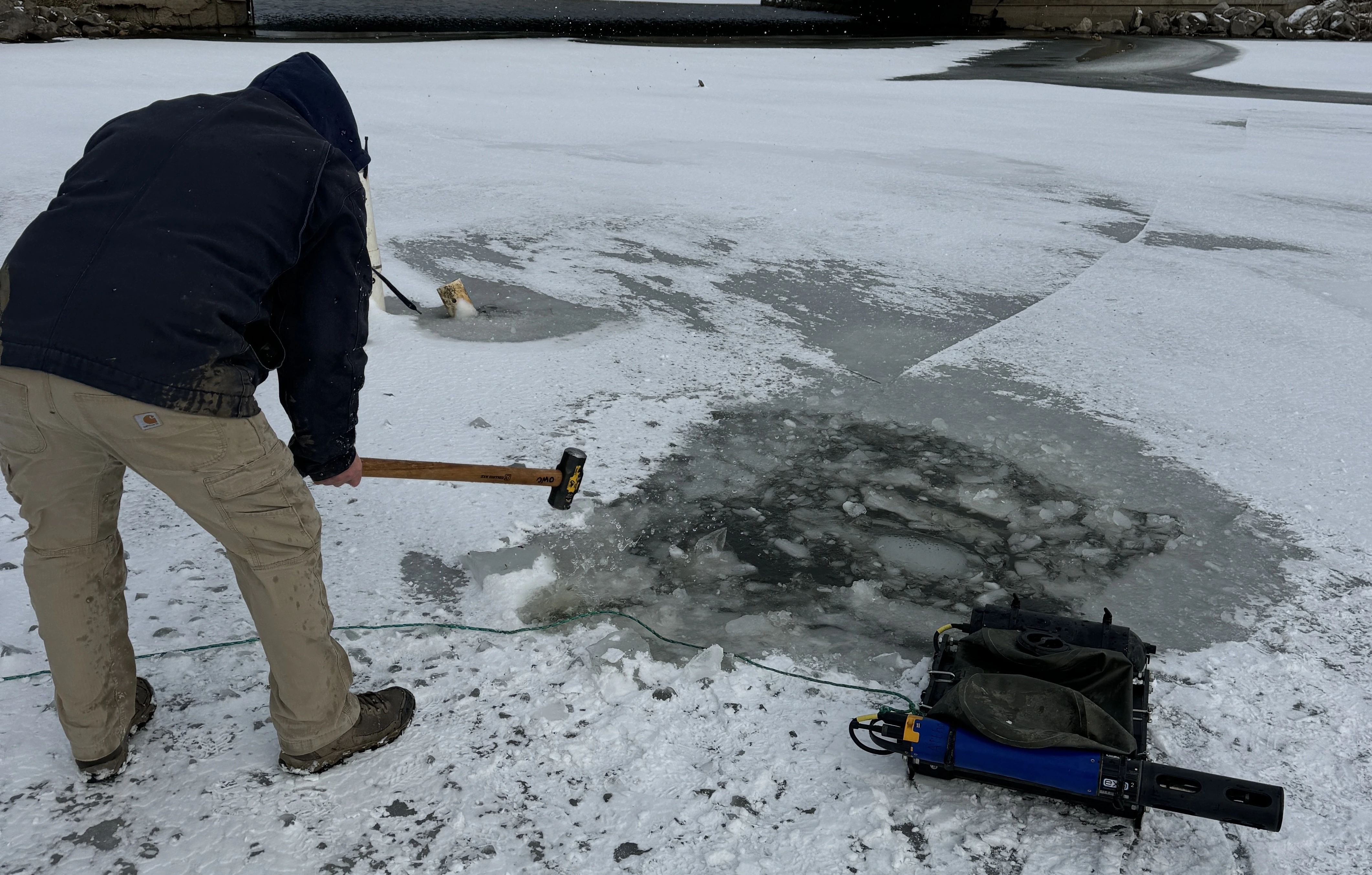
This season, CWA is launching its first formal winter deployments of international technologies, including underwater telemetry and monitoring devices, to trial their performance against ice, extreme cold, and frazzle ice risk assessment. Testing in winter conditions is critical for accelerating resilient water solutions to market.
Listen to this article
Cleveland Water Alliance’s extensive infrastructure allows tech companies to trial and demonstrate their solutions in a wide array of real-world conditions. This winter, we are expanding our program offerings to include our first formal winter technology deployments within the network. This initiative is crucial not only for gathering a more complete dataset on water conditions but also providing essential validation for cutting-edge technologies preparing to enter the global market.
Challenges of Winter Deployments
Historically, our testbed seasons have run in the spring and summer months and concluded before the winter season began. However, the transition to winter conditions introduces especially challenging dynamics that can make or break a technology's viability and success.
According to Emily Hamilton, CWA's Deal Flow Analyst, the main hurdle is ice.
"Our lake freezes over," she explains. "Sometimes it freezes completely and sometimes it partially freezes. But either way, that creates challenges for sensing and monitoring the conditions of the water. And also, some technologies are just not designed to be rugged enough for extreme temperature changes in either direction."
Winter conditions demand extreme durability and introduce new variables that developers must account for:
- Ice Formation: The physical presence of ice can damage equipment and block sensors, disrupting data transmission.
- Extreme Temperatures: Drops in temperature challenge the electronic components and battery life of devices.
- Frazil Ice Risk: High turbidity (cloudiness from non-water elements) in freezing temperatures leads to frazil ice—fractals that can gather at the entrance of water intake pipes. This directly affects the operational efficiency of drinking water utilities.
Filling a Critical Market Need: Ruggedized Validation
For technology companies, testing in extreme, rugged environments like Lake Erie in the winter is a valuable step on the path to commercialization. As Emily notes, the CWA testbed provides an opportunity for companies to evaluate performance in conditions they might not otherwise have access to.
"Part of the benefits of the CWA Smart Lake Erie Watershed testbed is the fact that we can provide all different types of conditions for deployment... We're providing the opportunity to evaluate the performance of the technology in a really difficult environment." – Emily Hamilton, CWA’s Deal Flow Analyst
Utilizing our testbeds to validate a technology's ruggedness and reliability makes it more vetted and credible for end-users globally. Our winter deployments directly address this need, helping innovators iterate on prototypes and bring market-ready, resilient solutions to market.
Two Cutting-Edge Winter Deployments
This year, we have already deployed one internationally sourced technology and are in the process of deploying a second. CWA's global technology scouting and partnerships connected us with these companies to trial their innovative solutions in the Great Lakes.
1. Underwater Telemetry for Uninterrupted Data
A significant challenge in winter monitoring is getting data through a layer of ice. One of our deployments features an underwater telemetry device that sinks to the bottom of the lake and uses electromagnetic field signaling to transmit data.
- The Innovation: This technology is designed to send signals through various substrates, including ice.
- The Impact: If successful, this deployment could revolutionize winter monitoring, opening up new possibilities for collecting reliable data on aquatic life, habitat change, and water conditions, even when the lake is frozen over.
2. A Modular Buoy Platform for Ice Detection
Our second deployment is a modular water monitoring buoy platform. Developed in Poland, a climate known for its cold, icy conditions, this technology is designed to be small and rugged, ideally capable of monitoring water conditions even in the presence of ice.
- The Innovation: With this deployment, we will be testing this technology’s ability to monitor for turbidity during the winter months.
- The Impact: Accurate, real-time turbidity data is critical because high turbidity leads to frazil ice, which can severely impact drinking water utility intake pipes. Monitoring for this parameter in the winter would help protect drinking water infrastructure.
The Value of Winter Monitoring
For CWA, these winter deployments represent a significant step forward in advancing our testbed capabilities and collecting continuous data that will help us better understand long-term environmental trends and strengthen our water monitoring efforts.
Our monitoring efforts have previously been challenged by winter conditions.
As Emily Hamilton notes, "Our lake freezes over. That creates challenges for sensing and monitoring the conditions of the water," limiting the data we can collect. By introducing remote, rugged devices, we can now close this critical data gap, extending our insights into the most challenging monitoring time of the year.
New Data for a Deeper Understanding
This expanded winter monitoring is essential because it allows us to gain a deeper understanding of environmental processes and factors critical to the health and management of the Great Lakes. Specifically, we are focused on collecting data regarding the conditions of the lake during the winter months, the behavior of aquatic life when the water is cold or frozen, and the thickness of ice that forms over time. This continuous data stream is vital because boots-on-the-ground monitoring in winter can be hazardous and challenging; remote sensing provides a safer, more reliable solution for gathering this information.
By enabling these crucial winter tests, CWA is simultaneously accelerating the commercialization of robust water technology and collecting valuable data. These inaugural winter deployments solidify CWA’s testbed network as a truly year-round resource, pushing the boundaries of freshwater monitoring and innovation.

.svg)