
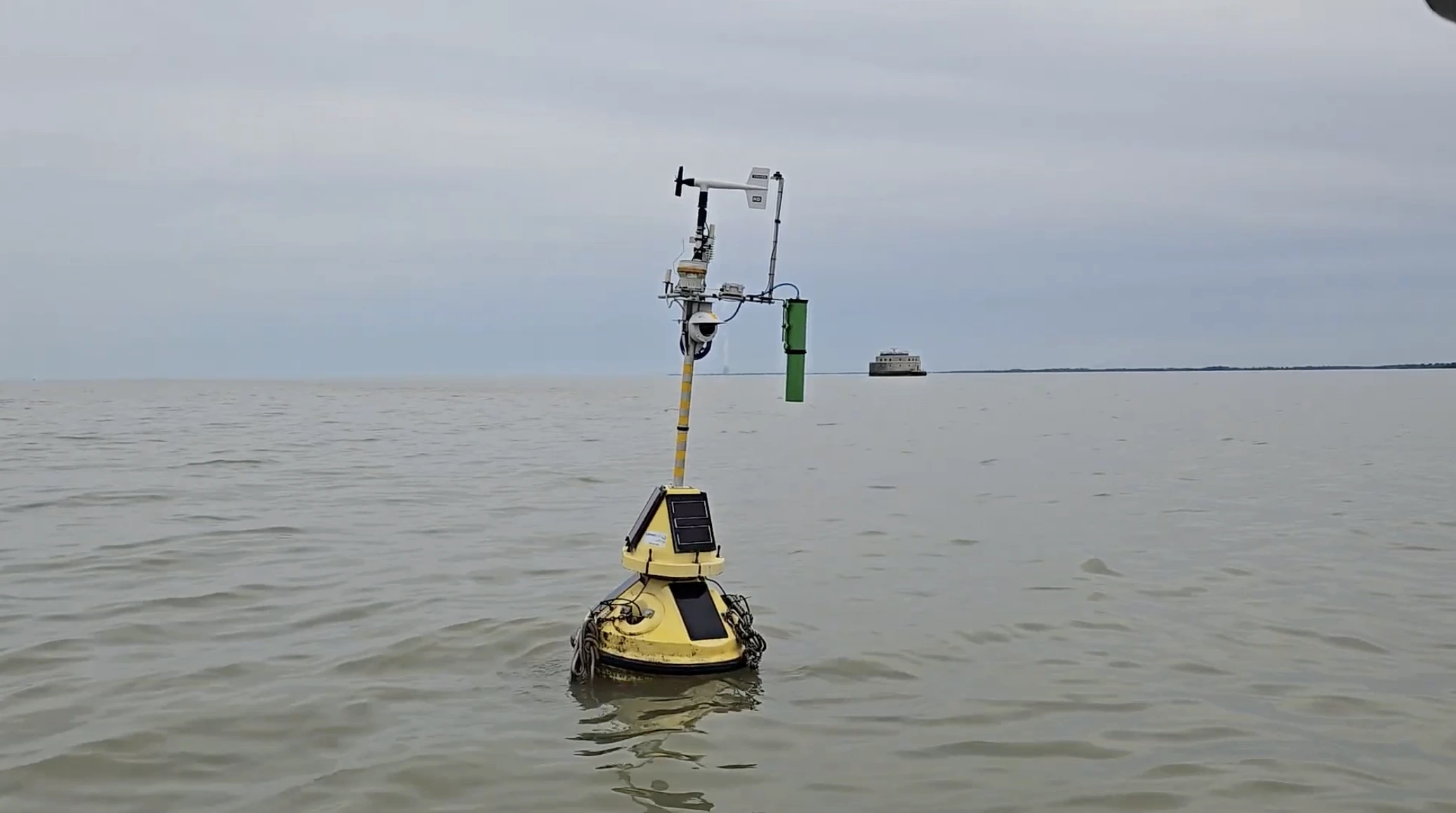
CWA has deployed LDI’s fouling-resistant algal bloom sensor on a buoy in Toledo, Ohio. This project highlights CWA's ability to support innovators through iterative deployments, providing the ongoing real-world data and user feedback they need to continuously refine their technology and fill gaps in the market.
Listen to this article
Each year, Cleveland Water Alliance (CWA) helps trial and validate innovative water technologies in real-world environments through our testbed network. This initiative provides tech companies with the robust data and feedback required to continuously evolve their systems. Because of this, CWA frequently supports iterative deployments, allowing innovators to return to the testbed after refining their designs and integrating user feedback.
As part of this year's cohort, we have just deployed a fouling-resistant algal bloom sensor from Laser Diagnostic Instruments (LDI), an innovative water tech company based in Estonia. LDI is returning to the testbed for their fourth season deploying with CWA, continuously iterating on their technology.
The Growing Threat of Harmful Algal Blooms
Harmful Algal Blooms (HABs) pose an ongoing and severe threat to freshwater ecosystems and regional economies across the globe. Driven by nutrient runoff and intensified by warming waters, these toxic blooms disrupt tourism, impact maritime industries, and create operational complexities for municipal drinking water treatment facilities.
To protect public health, wildlife, and local economies, rapid detection is crucial. However, traditional testing heavily relies on manual water sampling and delayed laboratory results. By the time a sample is collected, transported, and analyzed, a bloom may have already spread significantly. This time gap makes automated detection and real-time early warning technologies a critical advancement for the protection of our water resources. CWA works to identify and advance innovations that fill important market needs and operational gaps like this.
Early Identification of HABs: LDI’s Technology
Traditional in-water monitoring methods are highly prone to biofouling. When sensors are continuously submerged, algae, sediment, and biological gunk quickly build up on the optical lenses. This accumulation causes data inaccuracies, requiring frequent manual cleaning, expensive maintenance, and significant operational downtime.
LDI’s technology addresses this issue directly with their ROW: Algal Bloom Sensor.
How it Works: The ROW sensor uses a non-contact design, meaning it never actually touches the water. Instead, it mounts safely above the water's surface on a data buoy or structure. The sensor shines a specialized UV light down onto the water, which causes chlorophyll-a (the main pigment in algae) to naturally glow, or fluoresce. By measuring this glow, the sensor tracks algae levels 24/7 in real time.
The Problem It Solves: Because the sensor never physically touches the water, its design is engineered to eliminate biofouling on the lens. LDI notes that this allows for continuous operation with zero maintenance for a minimum of three years. This makes it an ideal solution for remote locations where sending out crews for frequent cleanings is difficult and costly. The system is built to automatically send out alerts the moment a biological threshold is reached, aiming to provide water managers with the early warning signatures required to act before a bloom becomes critical.
Repeat Testbed Users: Updating and Iterating
Innovation rarely happens in a single season. Several innovators return to CWA’s testbed network over multiple seasons to test their devices in different environments, trial new applications, and validate updates to their technology. By facilitating these repeat, iterative deployments, CWA provides the continuous real-world data and end-user feedback that companies need to refine their technology as it evolves, ensuring it is fully optimized and ready to enter the market.
“Water technology is complex and often requires rigorous, multi-season testing to be fully proven and validated. Our testbed program is built for long-term collaboration; it’s an ecosystem where companies can continuously iterate, upgrade, and demonstrate their tech against real-world conditions. Beyond trialing, CWA also provides the business support and end-user connections innovators need to become market-ready and successfully scale.” - Emily Hamilton, CWA’s Innovation Advocate & Deal Flow Analyst
Real-World Testing in Toledo
For this 2026 deployment, LDI’s ROW sensor has been installed on a data buoy in Toledo, Ohio, a region directly impacted by annual algal blooms. CWA works closely with innovators to identify the optimal deployment locations based on their specific technology goals and data-comparison needs.
"CWA helped greatly by offering us various integrated water quality sensors and their outputs, which helped us gain knowledge and improve our sensor," shared the LDI team. "By allowing us to collect valuable data for two consecutive years across different locations and water conditions, the testbed provided us the opportunity to compare our ROW sensor data with the submersible chlorophyll probes deployed at the same data buoy and nearby locations as the ROW.”
Advancing Tech to Protect Freshwater Ecosystems
By providing robust real-world data and structured feedback, Cleveland Water Alliance’s testbed network serves as a critical catalyst for identifying and advancing solutions that fill essential market needs and operational gaps across the water industry.
Stay tuned throughout deployment season as we share updates from LDI's deployment and introduce other exciting technology trials launching across the watershed this season!

.svg)


.webp)

.webp)
.webp)


