
Cleveland Water Alliance is trialing Bluesonde’s smaller, solar-powered buoy in our testbed, offering a cost-effective, low-maintenance alternative to traditional heavy monitoring equipment.
Listen to this article
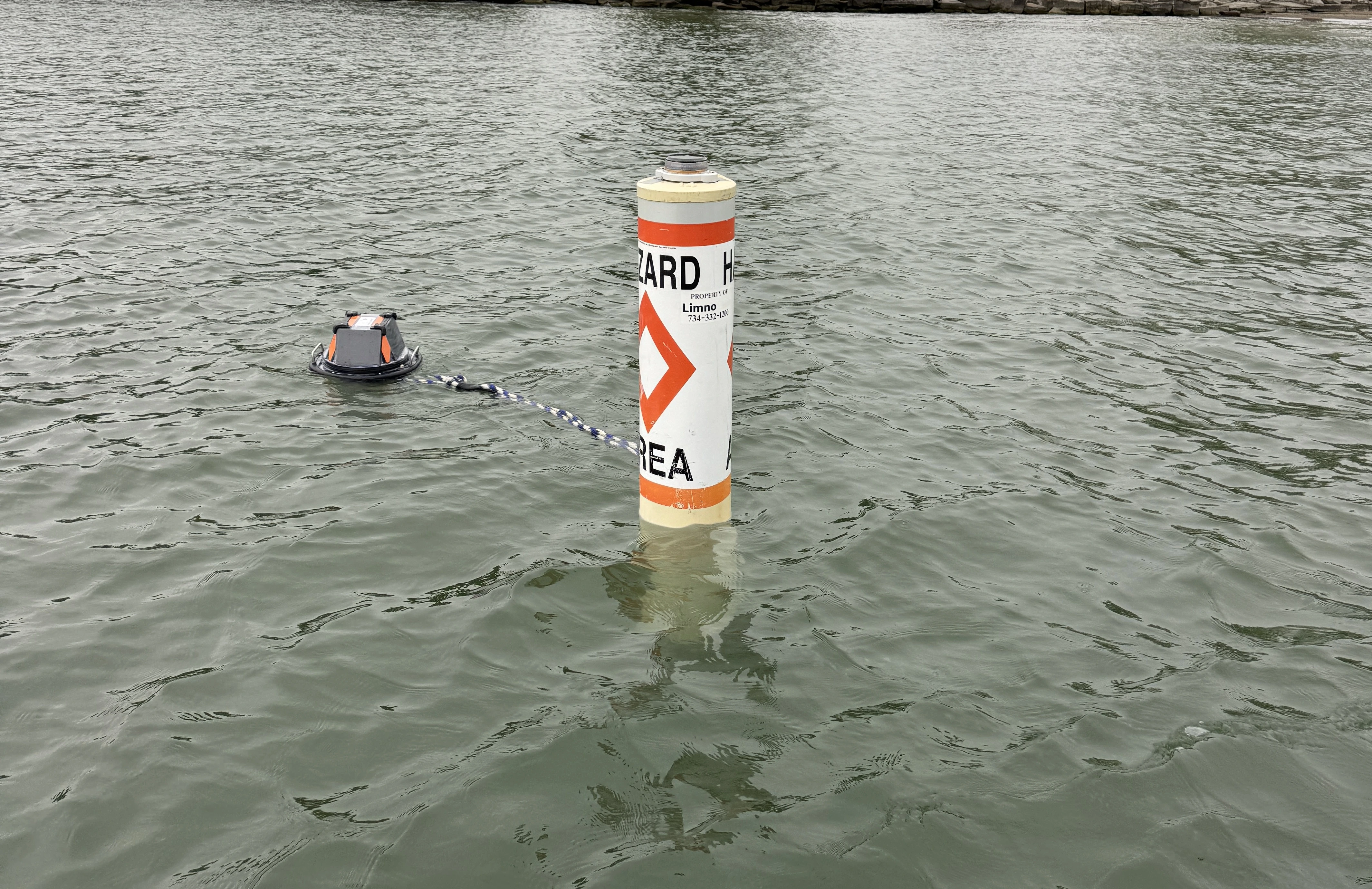
Deploying a typical water quality buoy is a complex, labor-intensive process. Often weighing hundreds of pounds, standard monitoring equipment usually requires heavy machinery, specialized vessels, winches, or cranes just to get into the water, costing water managers significant time and money.
As part of our 2026 testbed season, Cleveland Water Alliance (CWA) is trialing a smaller, more affordable alternative from Bluesonde in our testbed. Each year, CWA deploys select innovative technologies to test their performance in real-world conditions and evaluate how smaller, low-cost monitoring tools like this can expand data access for smaller organizations.
A Smaller, Solar-Powered Solution for Water Quality Monitoring
The Bluesonde unit is significantly smaller than traditional water quality buoys, being slightly larger than a basketball. Powered by compact solar panels and an internal battery, the buoy is designed for long-duration, unattended deployments.
As Emily Hyland, CWA’s Testbed and Sensor Technician, explained during the deployment:
"It's easy to lift, it's easy to put in. Compared to our other giant buoys, this one's much easier to deploy... And you don't need a crane or a winch to put it in the water, you’re able to just lift it by hand."
A key objective of this 2026 field trial is evaluating the buoy’s performance in Lake Erie’s open-water environment. The deployment provides an opportunity to characterize system performance across changing wave, wind, and weather conditions while demonstrating how a compact, lightweight platform can support monitoring in the Great Lakes.
Evaluating Hardware Performance
Bluesonde seeks to solve two major field challenges: maintenance demands and adaptable sensing.
- UV Anti-Fouling: A major hurdle in water monitoring is "biofouling", the natural buildup of algae, bacteria, or small organisms on underwater equipment that blocks optical sensors and corrupts data. Instead of mechanical wipers, the buoy uses integrated UV lights to help eliminate biofouling, reducing the need for frequent maintenance trips out on the water.
Tim Dyson, co-founder at Bluesonde, noted:
"Biofouling is one of the biggest challenges for water quality monitoring... The idea is you deploy the buoy at the beginning of the season, and then you take it out at the end. So it's truly kind of set and forget."
- Modular Sensor Setup: The buoy features customizable, interchangeable sensor ports. Depending on monitoring needs, operators can customize the sensors installed to track various parameters. For this trial, CWA is measuring temperature, conductivity, dissolved oxygen, turbidity, and fDOM (Fluorescent Dissolved Organic Matter).
Navigating the Complexities of Real-World Testing
Before a trial can happen, extensive coordination is required. Long before a piece of technology is exposed to Lake Erie’s unpredictable waves, harsh weather, and biofouling, getting a real-world trial launched takes significant preparation.
From coordinating with deployment sites and securing necessary federal agency permitting to navigating complex regulatory requirements, these administrative and logistical tasks can easily cause major hangups for tech companies. That’s why CWA and our partners handle all of the critical coordination and permitting to streamline the trial process, allowing innovators to focus on their technology.
Collaborating for Impact: Utilizing Partner Host Sites
Part of this facilitation includes partnering with other organizations for deployments. These collaborations create a mutually beneficial environment where CWA serves as the connector: host organizations get to trial cutting-edge innovations that address specific operational pain points or save time and money, while innovators gain access to real-world trials and crucial end-user feedback.
As Tim highlighted, "It's straightforward to set up a system in a tank in a lab... The next step is getting the system out into the real world with real end users. Having our product in the hands of a utility is very useful to see how they may use it. Utility customers have a different perspective than research or aquaculture, so it's great to get that feedback to understand what we should focus on."
Faster Safety Decisions
In Lake Erie, this trial evaluates how real-time buoy data can support public health and safety. Traditional bacteria testing often requires taking physical samples and waiting 24 hours or more for lab results. By gathering immediate, real-time data on indicators like turbidity and water temperature, the Bluesonde Buoy could help improve predictive models for beach monitoring.
"This will hopefully help our partners learn when they need to close the beach for E. coli-like substances in the water. It has the potential to be really helpful for beach monitoring and beach closures,” emphazised Emily.
Scaling Accessible Tech in Lake Erie
Validating accessible, low-maintenance technology is key to expanding water quality monitoring across the Great Lakes. By handling complex field logistics and bringing together innovators and local partners, CWA continues to accelerate practical solutions that strengthen local water infrastructure and enhance public safety.

.svg)


.webp)

.webp)
.webp)


