
Biofouling poses a major operational challenge for water quality sensors, making real-world trialing essential for validating technology before market entry.
Listen to this article
Algae are microscopic, plant-like organisms found naturally in water bodies like Lake Erie. In balanced amounts, algae are a key indicator of a healthy ecosystem. However, under certain conditions, such as warm summer temperatures and excess nutrient runoff, algal populations can rapidly expand to form Harmful Algal Blooms (HABs) that produce toxins and threaten regional water quality.
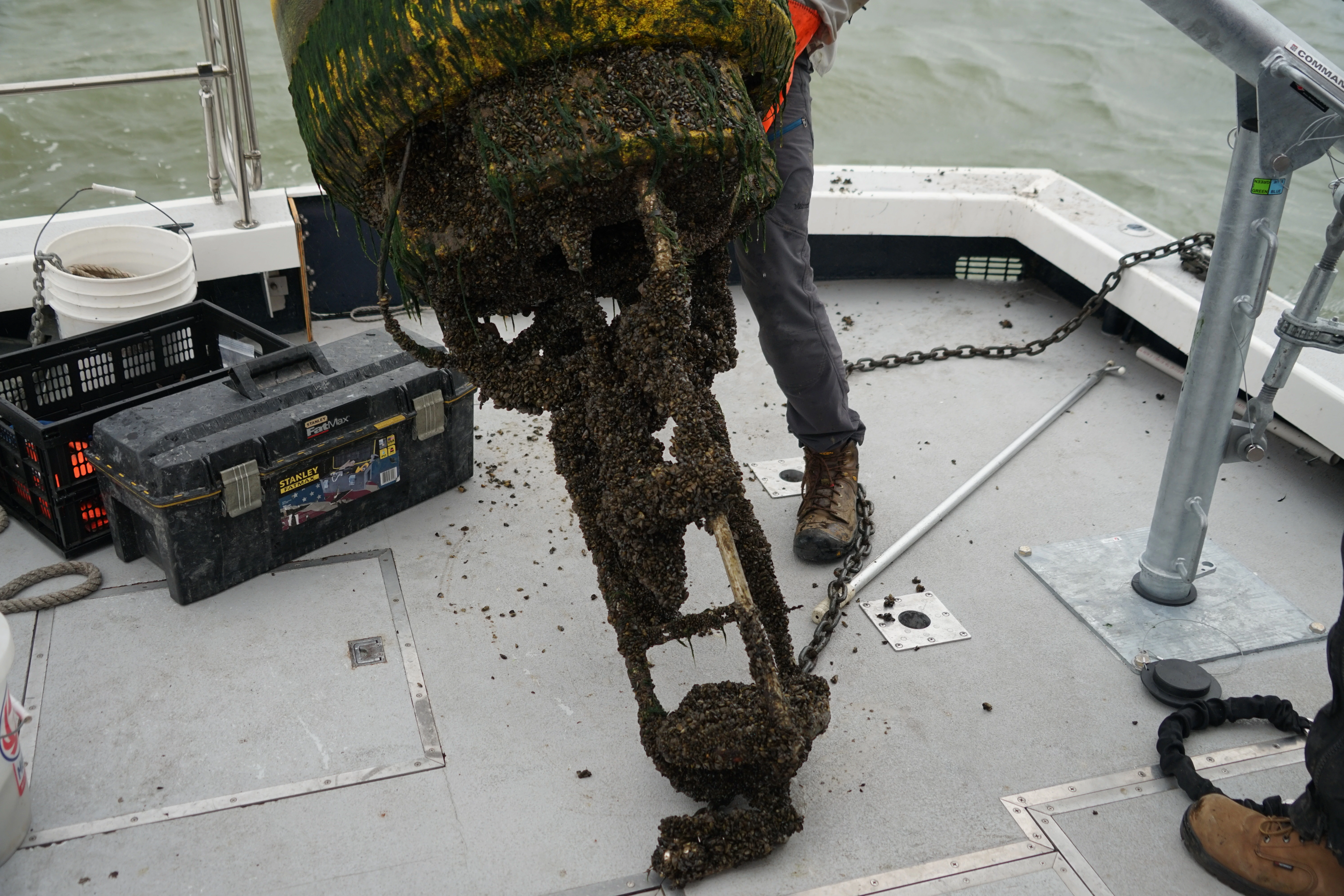
Beyond public health and environmental impacts, algae also present a direct operational hurdle for underwater sensors. As algae and other aquatic organisms attach to and grow on equipment, they create a common field issue known as biofouling.
What Is Biofouling and How Does It Happen?
Biofouling is the natural accumulation of microorganisms, algae, and small aquatic organisms on submerged surfaces. Regardless of location or water conditions, whether in oceans, rivers, streams, or lakes, biofouling is a universal challenge for any equipment deployed in natural environments.
It starts within minutes of placing equipment in the water as organic particles and bacteria attach to the surface, creating a thin, slippery film. Over time, larger plant growth and small aquatic organisms settle on this film and continue to expand. While biofouling happens year-round, it accelerates during the warmer summer months, coinciding with HAB season, when higher water temperatures and sunlight boost biological activity.
How Biofouling Impacts Water Quality Data
Modern water monitoring networks rely heavily on optical sensors. These devices shine precise beams of light into the water to measure parameters such as water clarity, dissolved oxygen, and specific pigments that signal the emergence of HABs.
When biofouling builds up on these instruments, it directly compromises data integrity:
- Blocked Sensors: Algae and buildup accumulate on the sensor lens, blocking or scattering light. This leads to false spikes, baseline drift, and inaccurate data.
- Altered Local Conditions: Organisms growing directly on a sensor consume oxygen and release biological waste. As a result, the instrument measures the biological growth on its own lens rather than the true conditions of the surrounding water body.
- Increased Maintenance: Untreated growth requires frequent field visits for manual cleaning, significantly increasing operational demands and field labor costs.
"Here in Lake Erie and the work that we do at Cleveland Water Alliance, we use a lot of optical sensors. That's what goes out on our buoys, and in order to get accurate data for stakeholders, innovators, and different water industry companies, we need accurate data... We need these different types of antifouling technologies to help make sure that we're able to provide that data and make sure that we're giving high quality and accurate data." - Emily Hyland, Testbed & Sensor Technician, Cleveland Water Alliance
Why Real-World Testing is Essential for Commercialization
Proving that a new sensor works in a laboratory setting is only the first step. Controlled lab environments cannot replicate the complex, living conditions of natural water bodies where biofouling actively occurs. Because biofouling is one of the most common failure points for submerged devices, real-world field trialing is critical to bringing new water technologies to market.
However, finding a freshwater environment to deploy and validate new technology is often a major hurdle in the commercialization process.
This is where Cleveland Water Alliance’s (CWA) testbed network and infrastructure provide immense value. CWA’s testbed gives innovators the opportunity to trial their technology in real-world conditions, evaluate device performance, compare data accuracy, and receive direct feedback from end users. This real-world exposure allows companies to see firsthand how biofouling impacts their devices, identify unexpected operational issues, and refine their technology before going to market.
"Our testbed gives innovators real-world experience in Lake Erie where conditions can be different. We have invasive zebra and quagga mussels that innovators might not have where a product was originally designed. Testing here shows how well their technology handles our specific lake conditions and helps broaden the impact their sensor can have." - Emily Hyland, Testbed & Sensor Technician, Cleveland Water Alliance
How Anti-Fouling Tech Keep Sensors Reading Accurately
Anti-fouling refers to any process, material, or mechanism designed to prevent organic growth from attaching to submerged equipment. By inhibiting or removing biological buildup, anti-fouling technologies preserve sensor accuracy, extend deployment times, and reduce the need for frequent manual maintenance or sensor retrievals.
To achieve long-term reliability in the field, water technology developers can incorporate several common anti-fouling strategies:
- Mechanical Wipers: Integrated automated wipers or brushes physically sweep across optical surfaces at scheduled intervals to clear away buildup before taking a reading.
- Copper and Metallic Materials: Utilizing non-corrosive materials like copper on sensor housings naturally deters biological growth on the device without harming the surrounding ecosystem.
- UV Light: Low-power ultraviolet (UV) light aimed directly at the sensor lens stops bacteria and algae from establishing a film.
- Acoustic Waves: High-frequency sound vibrations generate subtle physical forces that prevent organisms from sticking to surfaces.
- Protective Coatings: Clear, non-toxic coatings reduce surface energy, making it difficult for organic matter to attach.
From Innovation to Real-World Application
Biofouling remains one of the most critical operational challenges facing underwater sensors and monitoring technology today. Without effective anti-fouling strategies, biological growth can quickly compromise data accuracy, increase maintenance demands, and prevent new technologies from scaling effectively.
Through CWA’s testbed network, innovators gain access to real-world trialing to address biofouling and other potential operational issues. This allows companies to refine their hardware, optimize device performance, and verify data accuracy prior to entering the market.

.svg)


.webp)


.webp)
.webp)


