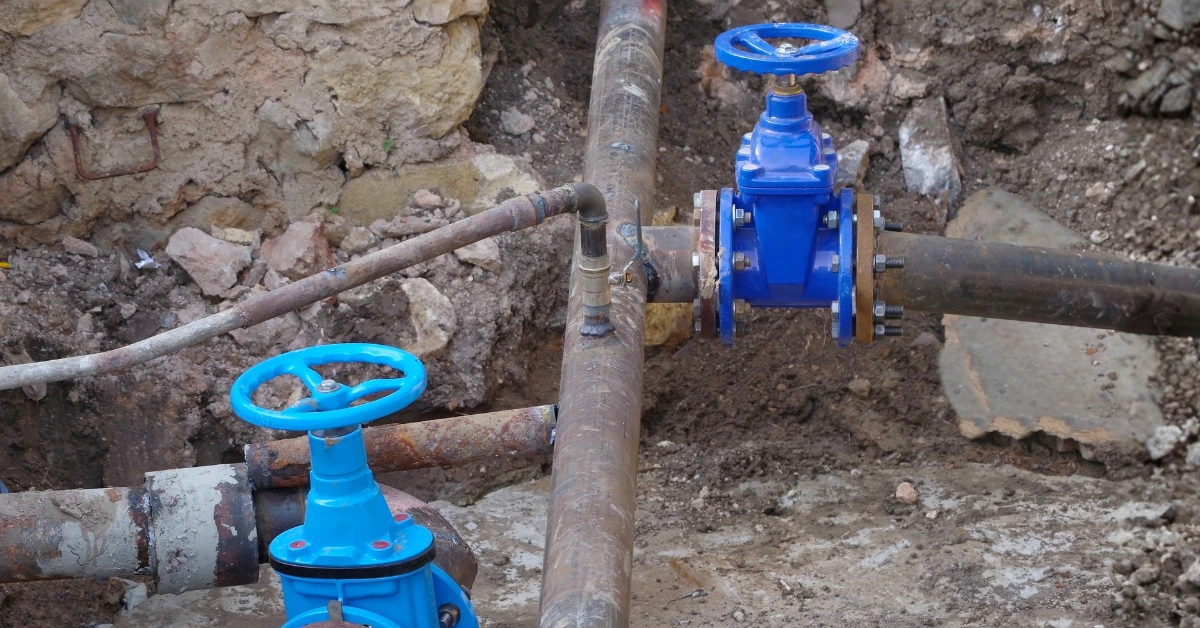
As new federal mandates require water systems to identify and replace all lead pipes, utilities face the massive challenge of mapping buried infrastructure. Cleveland Water Alliance is advancing innovative technologies that allow for pipe identification without the high costs, disruption, or excavation required by traditional methods.
Listen to this article
A new era for American water infrastructure began on October 8, 2024, when the EPA issued a final rule requiring drinking water systems to identify and replace every lead pipe within a 10-year window. While the initial deadline for submitting inventories was October 16, 2024, many compliance dates have since been pushed back to 2027. This shift has provided utilities more time to address a massive logistical hurdle: mapping buried infrastructure that has often remained unrecorded for nearly a century.
We recently hosted a webinar to discuss how the industry is moving toward advanced detection technologies to meet these federal mandates without the high cost and disruption of traditional excavation.
The Regulatory Challenge
The standard method for verifying pipe material has long been "potholing," which involves physically digging a hole to inspect the line. However, the financial cost of this method is immense. CWA’s Innovation Advocate and Deal Flow Analyst, Emily Hamilton, pointed out that digging up a single lead service line to look at it and determine the material could cost up to $1,800 in Cleveland.
The scale of this challenge is particularly clear in cities like Cleveland, where the utility maintains over 400,000 service lines. Approximately 140,000 of these are suspected to be lead, but there is no way to be certain without physical verification. Under current rules, "unknown" materials must be labeled as "lead" or "lead status unknown," essentially mandating their removal unless they can be proven safe.
The Impact of Traditional Identification
Beyond the high cost, traditional identification methods are inherently disruptive. Potholing requires heavy machinery, often resulting in torn-up sidewalks, blocked traffic, and significant noise for residents. Furthermore, many utilities rely on visual inspections inside the home to identify pipe materials. This creates a logistical challenge for both the city and the citizen, as it requires scheduling appointments, gaining access to private basements or crawl spaces, and relies on the homeowner being present.
Historical records are not a reliable source either when trying to avoid these disruptions. Timothy Preager, COO of Solinas Technologies, shared that early in their development, they tested 100 sites where records indicated lead, only to find the documentation was incorrect and misleading. Similarly, Ivan Bartoli of Drexel University observed that even when a utility uses a visual inspection from inside a basement as their primary way to confirm a material, it can still be unreliable. This is because what you see inside the house isn't always what is under the street; service lines often consist of multiple segments made of different materials that aren't visible from the interior.
Advancing Innovative Technologies
CWA has supported several LSL detection technologies, providing funding, mentorship, and support through our Open Innovation Challenge, as well as access to Cleveland Water's Lead Service Line Research Facility. The two technologies highlighted during our webinar were:
- Acoustic Vibration Signature (Solinas Technologies): This method injects acoustic signals into the pipe to hear how the system responds. "You can imagine a copper pipe that might ring more than a lead pipe," Preager explained. "Lead has a lot more damping or a loss factor compared to copper. That's why you get the thud versus the ping."
- Stress Wave Propagation (Drexel University): This approach, led by Ivan Bartoli, uses a small hammer to create an impact at the curb stop valve, creating waves that travel along the pipe. To identify the material, the system analyzes how these waves leak energy into the surrounding soil. Because lead is a much softer, "lossy" material compared to rigid materials like copper or steel, the waves behave differently. By measuring these specific energy patterns, the team can distinguish a lead pipe from other materials with high accuracy.
[Callout 1]
Refining the Tools for the Field
One of the most significant steps in this journey was the transition from a university research tool to a field-ready prototype. CWA facilitated this by connecting the Drexel team to Prodigy Product Development and providing a $15,000 grant for prototyping support.
The original research prototype required two people to operate and was sensitive to weather conditions like rain. The redesigned version is built for single-user operation and is engineered to function in various weather conditions, allowing for much faster and more reliable data collection in the field.
Testing in the Field: The LSL Research Facility
The ability to test these technologies in a controlled yet realistic environment was vital for their development. Timothy Preager explained that the Cleveland Water Lead Service Line Research Facility provided innovators with known materials and a common setup that was almost identical to what they find in the field.
The facility features different types of ground and substrates, such as clay or sand, allowing teams to see how soil composition affects their detection signals.
"That's where all the specifics and the nuances of the acoustics, testing, and the methodology were really sort of hammered out," Preager explained.
By having a dedicated space to replicate the exact conditions utility crews face, the innovators could validate their data and refine their hardware.
Meeting Mandates with Smarter Tech
As regulatory deadlines approach, the need for reliable detection technologies has never been more urgent. These new tools make it much easier to identify pipe materials without the high cost of digging or the disruption to homeowners and local traffic. They represent a shift toward a smarter, data-driven approach to infrastructure management. By providing funding, expert mentorship, and access to world-class testing facilities, CWA helps ensure that new regulations can be met with practical, scalable solutions.

.svg)


.webp)


.webp)